

Self Loading Cutter Wagon for Feeding Ducks and Geese
A Self Loading Cutter Wagon for ducks and geese can significantly improve the harvesting and transport of fresh green forage. This solution is particularly useful on farms where birds do not have permanent access to pasture or where fresh grass is collected and delivered directly to the poultry house or outdoor enclosure.
One machine can cut, collect and transport green forage in a single operation. This reduces manual work and makes it easier to provide birds with fresh plant material regularly throughout the growing season.
Green forage in the feeding of ducks and geese
Geese are natural grazing birds and can make good use of pasture and fresh green forage. Ducks can also benefit from access to fresh plant material, especially in outdoor and semi-intensive production systems.
Depending on the farm and the feeding system, green forage may include:
- grasses,
- clover,
- lucerne,
- young cereal plants,
- herbs,
- other suitable forage crops.
The ration should always be adapted to the species, age and production stage of the birds. Fresh green forage should therefore be treated as part of a properly balanced feeding programme rather than as a complete replacement for compound feed.
Its nutritional value also depends on the plant species, harvesting date and growing conditions. Young plants are generally more palatable and easier for birds to consume than mature, highly fibrous forage.
Why harvest green forage mechanically?
On a small farm, grass can be cut and transported manually. However, this becomes increasingly difficult as the flock grows or the distance between the field and the poultry house increases.
A Self Loading Cutter Wagon combines several operations:
- cutting standing forage,
- collecting it directly into the loading body,
- transporting it to the feeding area,
- unloading it at the required location.
The forage does not have to be cut with one machine, collected manually and loaded onto a separate trailer. The entire operation can be completed using one tractor and one Self Loading Cutter Wagon.
How can a Self Loading Cutter Wagon help duck and goose farms?
Regular harvesting of fresh forage
Fresh green forage is most valuable when it is harvested at the appropriate growth stage and used without unnecessary delay.
A Self Loading Cutter Wagon allows the operator to collect the amount required for current feeding instead of harvesting a large quantity at once. This can help maintain forage freshness and reduce losses caused by heating or deterioration during storage.
Reduced manual work
Cutting and collecting grass manually is time-consuming, especially when fresh forage must be delivered every day.
Mechanical harvesting reduces physical work and allows one operator to collect and transport a considerably larger amount of forage in less time.
Better use of available grassland
Not every farm can provide ducks or geese with direct access to all available grassland. Some fields may be located too far away, separated by roads or unsuitable for fencing.
In these situations, green forage can be harvested mechanically and transported directly to the birds. This allows the farm to use fields that would otherwise be difficult to include in the feeding system.
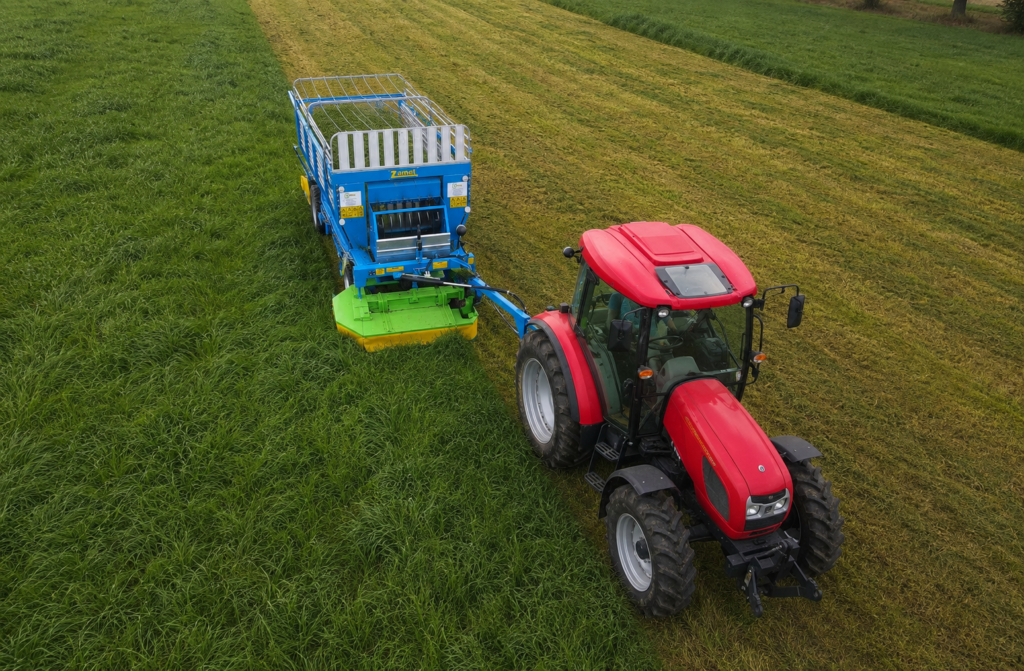
Cutting and loading in one operation
The mower unit cuts the standing forage, while the loading system transfers it directly into the wagon body.
The extended drawbar allows the tractor to travel over the already cut area while the offset cutting unit and wagon work in the standing crop. Both the tractor and the machine move in the same direction.
This arrangement makes it possible to harvest clean strips of green forage efficiently without requiring an additional collection stage.
When does this solution make the most sense?
A Self Loading Cutter Wagon can be particularly useful when:
- the farm keeps a larger flock of ducks or geese,
- birds have limited or seasonal access to pasture,
- fresh forage is collected from fields located away from poultry buildings,
- supplying green forage requires too much manual work,
- the farm wants to use its own grassland more efficiently,
- one machine is expected to cut, load and transport the forage.
The profitability of the machine depends not only on the number of birds but also on the amount of forage harvested, transport distance, frequency of use and availability of labour.
What should be considered when harvesting green forage for birds?
A Self Loading Cutter Wagon improves harvesting and transport logistics, but it does not determine the nutritional quality of the ration. Several basic rules should therefore be followed.
Harvest clean forage
The material should be free from soil, stones, waste and harmful plants. Particular care is required when harvesting fields with an unknown botanical composition.
Avoid spoiled material
Mouldy, overheated or heavily contaminated forage should not be fed to birds. Freshly harvested material should be used promptly or stored under suitable conditions.
Select the correct harvesting stage
Very mature plants contain more structural fibre and may be less palatable. Harvesting younger forage generally makes it easier for ducks and geese to consume.
Introduce dietary changes gradually
Any significant change in the ration should be introduced gradually. The amount and type of green forage should be adapted to the production system and, when necessary, discussed with an animal nutrition specialist.
Keep the machine clean
The loading body, cutting unit and unloading system should be regularly inspected and cleaned. This is particularly important when the Self Loading Cutter Wagon is used for daily harvesting.
Which ZAMET Self Loading Cutter Wagon should you choose?
ZAMET Self Loading Cutter Wagons are available in three capacities. The appropriate model should be selected according to the amount of green forage required, the size of the farm, the available tractor and the distance between the field and the feeding area.
| Model | Loading capacity | Recommended application |
|---|---|---|
| T635 | 14.5 m³ | Regular green forage harvesting on small and medium-sized farms |
| T635/1 | 19 m³ | Larger flocks and farms requiring more forage per harvesting cycle |
| T635/3 | 24 m³ | Large-scale harvesting, high daily forage demand and longer transport distances |
Each model combines cutting, loading, transport and unloading in one operation. This makes it possible to choose the appropriate capacity without changing the basic harvesting method.
ZAMET Self Loading Cutter Wagons can be used not only on cattle farms but also by duck and goose producers, herb growers, municipal services and organisations responsible for maintaining meadows and natural areas.
Is a Self Loading Cutter Wagon suitable for every poultry farm?
Not necessarily. For a small flock with unrestricted access to good pasture, purchasing a specialised machine may not be economically justified.
However, it can be a practical investment for farms that regularly harvest substantial quantities of fresh forage, keep birds in several locations or want to reduce their dependence on manual work.
The most important factor is not simply the number of ducks or geese, but the entire harvesting and feeding system used on the farm.
Summary
A Self Loading Cutter Wagon for ducks and geese can simplify the regular harvesting of fresh green forage. By combining cutting, collection and transport in one operation, the machine reduces manual work and allows farms to use their own grassland more efficiently.
It does not replace a properly balanced ration, but it can become an important part of an organised green-forage feeding system, particularly on larger farms and wherever direct access to pasture is limited.
Would you like to select the right Self Loading Cutter Wagon for your farm? Contact ZAMET and tell us more about your flock, available tractor and current feeding system.