


Feed Mixers and TMR Structure: How to Avoid “Over-Processing” the Ration and Support Rumen Health
Feed Mixers and TMR Structure: How to Avoid “Over-Processing” the Ration and Support Rumen Health
Feed mixers make TMR preparation easier, but how you mix can be more important than the formulation itself. Excessive mixing with a feed mixer can “grind down” the ration, reduce effective fiber, and compromise rumen health—even when the balance looks correct on paper.
Below you will find practical guidelines on how to maintain good TMR structure and avoid situations where the feed becomes too fine or easily sorted.
Feed Mixers and TMR Structure—Why It Matters
TMR should function as a stable, consistent meal: delivering energy, protein, and minerals, while also maintaining proper rumen function. The key is TMR structure—the length and proportion of particles in the ration and whether there is “something to chew” in the feed.
If the feed becomes too fine and uniform, cows often eat faster and the rumen is more prone to acidosis. This increases the risk of digestive problems and reduced efficiency.
Feed Mixers: How to Mix Without “Over-Processing” the Ration
Effective fiber is the portion of fiber that actually stimulates chewing. And chewing means:
If feed mixers operate too long on the ration, the particle size can become too fine—resulting in less chewing.
What an “Over-Processed” Ration from a Feed Mixer Looks Like
The most common scenario: silages, straw, or other components are chopped so short that the TMR loses structure. Such a ration:

Signs That Structure Is Too Weak
Watch for a combination of signals (not a single symptom):
- fewer cows chewing at rest,
- looser manure, “bubbles,” undigested particles,
- drop in milk fat (often with overly fine rations),
- increased nervousness at the feed bunk, pushing,
- sorting: some animals select the “tastier” parts, others are left with the rest.
These may be signs that TMR structure and effective fiber are too low.
Where the Problem Comes From—5 Common Causes
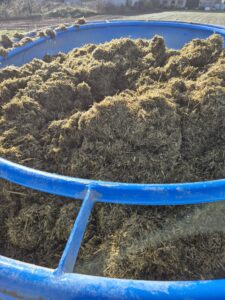
- Excessive mixing time after loading the last ingredient.
- Incorrect loading sequence (components are added to the mixer in random order).
- Overly aggressive cutting or improperly adjusted stationary knives.
- Worn knives—instead of clean cutting, there is “tearing” and uneven particle size.
- Insufficient structural component (e.g., straw) or poorly prepared structural component.
Feed Mixers: How to Mix Without “Over-Processing” the Ration
The checklist below is simple but effective—especially when the problem is overly fine particle size.
1) Establish a Standard Mixing Time
Most often, “grinding” begins after the ration is already fairly uniform and the operator gives it “just a bit longer.”
Establish a rule: mixing after loading the last ingredient should last only as long as needed to achieve uniformity—without extra minutes.
2) Follow a Logical Loading Sequence
In many operations, the following sequence works well:
- components requiring initial “loosening,”
- then silages,
- finally fine components (meals, premixes), to avoid mixing them too long.
This reduces the risk of the feed mixer “working” on a finished ration.
3) Monitor Sorting (Often the Key to the Problem)
If cows are sorting, it is often a sign that:
- the structure is too long (easy to select), or
- the ration is too fine and “floury,” so cows seek out tastier particles.
Always observe behavior at the feed bunk and refusals after a few hours.
4) Check Working Components and Settings
In the context of feed mixers, details make the difference:
- sharpness and condition of knives,
- stationary knife adjustment,
- speed and operating method,
- process adaptation to the type of silages and components.
The same TMR formulation can produce different results if knife condition or mixing time changes.
5) Do Not Pursue “Perfect Uniformity” at the Expense of Structure
TMR does not need to look like poultry feed. The goal is a mix in which:
- cows do not sort,
- there is sufficient fiber for chewing,
- and the ration is stable and repeatable day after day.
In practice, feed mixers deliver the best results when you maintain a consistent loading sequence and do not extend mixing time “just to be safe.”
Quick On-Farm Test: 3 Days of Observation
Conduct a simple test without overhauling the formulation:
- Day 1: standard mixing.
- Day 2: reduce mixing time after loading the last ingredient by approximately 20–30%.
- Day 3: return to standard or refine the loading sequence.
Observe:
- number of cows chewing,
- manure,
- behavior at the feed bunk,
- quantity and structure of refusals.
If improvement is clear after reducing mixing time, this is a strong signal that the ration was previously “over-processed.”
Properly configured feed mixers help maintain TMR structure, reduce sorting, and support rumen health.
Feed mixers can be a tremendous asset in TMR preparation, but it is easy to overdo mixing time and “destroy” ration structure. Controlling TMR structure, effective fiber, and simple feed mixer operating parameters helps maintain stable intake and better rumen health.