
Feed mixer wagons make it easier to prepare TMR, but how you mix is often more important than the recipe itself. Mixing for too long in a feed mixer wagon can “grind” the ration, reduce physically effective fiber (peNDF), and harm rumen health — even if the numbers look perfect on paper.
Below you’ll find practical tips on how to maintain good TMR structure and avoid a ration that becomes too fine or easy to sort.
Feed mixer wagons and TMR structure – why it matters
TMR should work like a stable, consistent meal: it must deliver energy, protein, and minerals, while also supporting proper rumen function. That’s why TMR structure is so important — the particle size and distribution in the ration, and whether the feed still contains enough “chewable” material.
If the ration becomes too fine and uniform, cows often eat faster and the rumen can acidify more easily. This increases the risk of digestive issues and reduces overall efficiency.
Feed mixer wagons: how to mix without “grinding” the ration
Physically effective fiber is the part of fiber that actually stimulates rumination. And rumination means:
-
more saliva (a natural buffer),
-
more stable rumen pH,
-
better fermentation,
-
and ultimately better rumen health.
If feed mixer wagons run too long on the ration, the particle fraction can become too fine — and then rumination drops.
What a “ground” ration from a feed mixer wagon looks like
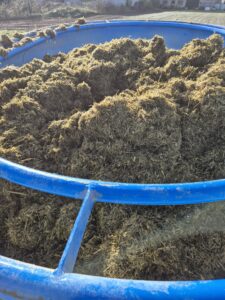
The most common scenario: silages, straw, or other components are chopped so short that the TMR loses structure. Such a ration:
-
looks very uniform,
-
compacts easily,
-
feels “mealy” to the touch,
-
and at the same time cows ruminate less because they have nothing to “work on”.
Signs that the structure is too weak
Look for a set of signals (not just one symptom):
-
fewer cows ruminating while resting,
-
looser manure, “bubbles”, undigested particles,
-
lower milk fat (often with overly fine rations),
-
more nervous behavior at the feed bunk, pushing,
-
sorting: some animals pick the “tastier” bits and others are left with the remainder.
These can indicate that TMR structure and physically effective fiber are too low.
Where the problem comes from – 5 common causes
-
Mixing too long after the last ingredient is added.
-
Poor loading order (ingredients added in a random sequence).
-
Overly aggressive cutting or incorrect counter-knife settings.
-
Worn knives — instead of clean cutting you get “tearing” and uneven particle size.
-
Not enough structural component (e.g., straw) or a poorly prepared structural component.
Feed mixer wagons: how to mix without “grinding” the ration (checklist)
This checklist is simple, but it works — especially when the issue is an overly fine ration.
1) Set a mixing-time standard
“Grinding” usually starts after the ration is already fairly uniform, and the operator keeps it running “for a bit longer”.
Make it a rule: mixing after the last ingredient is loaded should last only as long as needed to blend the ration — no extra minutes.
2) Keep a logical loading order
In many farms, a good sequence is:
-
ingredients that need initial “loosening” first,
-
then silages,
-
fine ingredients (meals, premixes) last, so they aren’t mixed too long.
This reduces the risk that the feed mixer wagon will keep working on an already-finished ration.
3) Watch sorting — it’s often the key clue
If cows sort, it may mean:
-
the structure is too long (easy to pick out), or
-
the ration is too fine and “mealy”, so cows search for the more palatable particles.
Always observe behavior at the feed bunk and check refusals a few hours later.
4) Check working parts and settings
With feed mixer wagons, details matter:
-
knife sharpness and condition,
-
counter-knife settings,
-
mixing speed and mixing method,
-
matching the process to the type of silages and ingredients.
The same TMR recipe can produce a different result if knife condition or mixing time changes.
5) Don’t chase “perfect uniformity” at the expense of structure
TMR doesn’t need to look like poultry feed. The goal is a mix where:
-
cows don’t sort,
-
there is enough fiber to stimulate rumination,
-
the ration is stable and repeatable day after day.
In practice, feed mixer wagons perform best when you keep a consistent loading order and avoid extending mixing “just in case”.
Quick on-farm test: 3 days of observation
Do a simple test without changing the recipe drastically:
-
Day 1: your standard mixing routine.
-
Day 2: shorten mixing after the last ingredient by about 20–30%.
-
Day 3: return to standard or fine-tune the loading order.
Observe:
-
how many cows are ruminating,
-
manure,
-
behavior at the feed bunk,
-
the amount and structure of refusals.
If shortening mixing brings a clear improvement, it’s a strong sign that the ration was previously “over-processed”.
Well-adjusted feed mixer wagons help maintain TMR structure, reduce sorting, and support rumen health.
Feed mixer wagons can be a huge help in preparing TMR, but it’s easy to overdo mixing time and “kill” the ration’s structure. Controlling TMR structure, physically effective fiber, and a few simple operating parameters of the feed mixer wagon helps maintain stable intake and better rumen health.